East Otero School District Meet & Confer Highlights Payroll Issues, Teacher Concerns and Calls for District Reforms
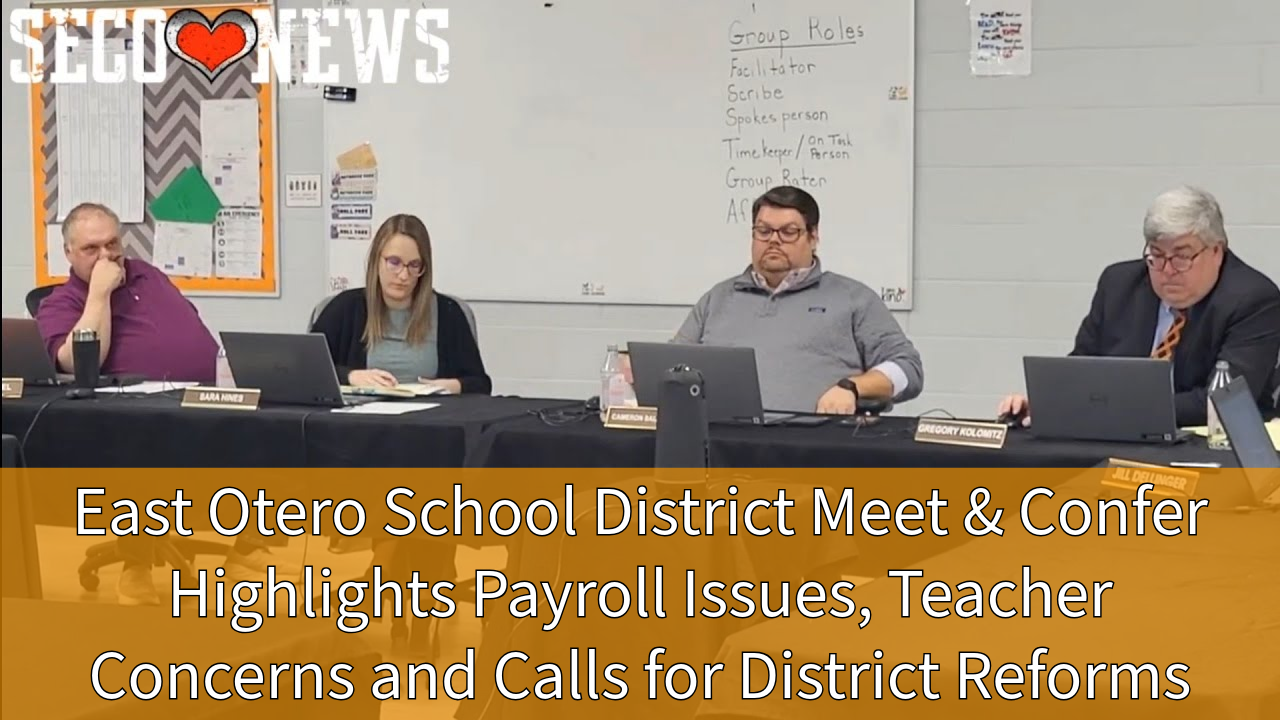
Description: During the Feb. 17, 2026 East Otero School District Meet & Confer, teachers raised concerns about payroll problems, financial transparency, staffing stability, curriculum practices, and district policies, urging stronger communication and long-term sustainability. Read the notes from EOSD teacher Danielle Dwyer...

East Otero School District Meet & Confer Feb 17, 2026
INTRO:
• Danielle Dwyer, EOSD employee entire teaching career, currently on year 21.
• Thank you for the opportunity to speak with you today.
• It is honorable that our new leadership in both the board of education and administration are working diligently to acknowledge and rectify the challenges presented with the financial crisis and student/teacher success in our district. Additionally, our building administrators have worked tirelessly, dedicating immense amounts of time and devotion to the success of both staff and students.
• As we welcome new board members and administrative leadership, this is a great opportunity to work together towards solidifying processes, procedures, and policies within our district that will benefit positive growth for students and staff.
• My goal in speaking with you today is to highlight some of the history and practices within the district over time. In order to effectively express any concerns or needs of the district that are weaved into the history, I find it prudent to build your background knowledge which could assist in both ongoing and future endeavors to make our district excel in excellence. My delivery will begin with financial history/issues, followed by a bit of history to show systematic practices and losses within the district over time as well.
• I'd like to begin by highlighting some of the financial history and issues staff have already faced and follow with how, historically, similar issues also began to happen within district systematic practices as well.
HISTORICAL FINANCIAL ISSUES & CURRENT CONCERNS:
• Administration Snapshot: (5 superintendents, 6 principals)
• Glen Gustafson (Mr. Scarf Man): Explained how our district's financial crisis is likely a result of the CO trending challenge of turn over with both business managers and Superintendents.
• Glen stated that administration turnover was a potential factor in our financial crisis.
• Please note that until 2024, the same administration was in chair for a term of nine years and many staff members began to have ongoing payroll issues beginning in 2021. To be clear, this was a time in which HR and business manager turnover rates did become high in our district.
• Through district wide emails, many issues that were happening within payroll began to unravel that were either announced by the superintendent, or brought up by staff. These issues ranged from:
■ Tax withholdings being incorrect or completely absent regardless of W2 claims
■ PERA funds not being deducted OR some staff had issues with either no match funds deposited or no PERA being deducted at all.
■ FSA accounts that were not paid by the district after deducting the fees from staff.
■ Open enrollment health care and/or benefit opt in/opt outs, including FSA accounts, that were missing or incorrect once the new term began. Some staff who closed FSA accounts during open enrollment still had it pulled from their payroll deductions the following term even though they had no FSA enrollment or account.
■ Staff were not paid on June 24, 2022 which marked the third time the same issue had happened within recent years (staff blew up) AND the payroll that did finally come was short (addressed in email from Lovato 7/6), This was rectified eventually, but not without some good old weird deduction issues due to the way the checks were issued.
■ Switch from SDS to ADP payroll in January 2023 was a nightmare and significant deduction problems began on the very first payroll in January (this went on for more than a year did not end until the switchover back to SDS in June(ish) of 2024),
■Longevity pay mistake issues in January 2024
■ As of November 2024 many staff members still had tax returns held by the IRS after filing for 2023 because the district did not report half of the income to the IRS. This is the same year the district had two W2s from both SDS and ADP. Fun fact: the funds were finally deposited from the IRS by December 2024, but the IRS then served these staff members with a form to claim it as income the following tax season.
■ These are just a few of the issues that I was aware of or personally affected by and there are likely more issues that are not listed.
o The "irregularities" that Glen mentioned as reasons for the deep digs in an audit are of no surprise to those of us who endured payroll woes over the years. Regardless of the issues being reported to both the superintendent and board members at the time, they continued.
o Recent efforts to rectify this through Abacus are most appreciated. However, there are once again differences in how the payroll is now taxed, deducted, and presented overall.
o Bear in mind that we know any cost of living increases or any salary and longevity concerns cannot be thought of right now, but they have lingered over time as well with no forward motion for years.
o Amongst typical cost of living increase and longevity term concerns, there was a payroll increase that took place (2017?) in which staff were bumped up in steps rather than a salary increase made to the scale. This resulted in staff being pushed ahead anywhere from one to four years on the scale which cost them the same amount of years in terms of ability to move "up" the ladder on the current pay scale. Many staff felt cheated from their ability to keep up with cost of living in terms of the amount of years they can climb the payscale.
o We understand your financial crisis, but now you know much more about ours.
REQUESTS (FINANCIAL):
• Although we want to trust that our district is on the right track now, we hope that you understand the trauma we have been through and the confusion we have had with how to accurately understand our payroll and deductions. Our request to have it explained was never honored.
• Currently, some staff would like to understand the new payroll system as far as how it is showing taxes, deductions, and fringe benefits differently than what it was before & why which cannot always be easily phrased and processed through email,
• There are also concerns about lack of thorough communication to inform staff of said changes.
• The "HR" department does not have on site availability to support staff which is also concerning. Current "HR" questions are to be emailed to a finance team, which includes Kim at Abacus, Jared Wilson our curriculum director, Richard Romero our Safety and Security Coordinator, & Patrick Krumholz our Superintendent. Questions raised (with no offense to those who have stepped up to help) were: Is anyone with business administration background on this team apart from Kim who manages the finances? Is it not a conflict of interest for employees with these positions/titles to manage the personal information of staff?
• The EOSD staff should have trust in the fiscal management processes in place and we have lost that over the years. We depend on our board of education and leading administration to manage this responsibility. We see that you are trying to get us back on track and we do thank you for that effort.
• Above all, we desperately need you to consider how to help sustain our district's financial infrastructures while taking into account known factors such as the high turnover rate in this department and how to ensure that proper training, background, and management procedures are in place for the persons performing these roles.
HISTORICAL SYSTEMATIC PROCEDURE LOSS, CONCERNS, & REQUESTS:
• Another thing Glen mentioned in regards to the high turnover rate of administration and business managers was that, "when you start turning them over repeatedly, you lose all of that corporate memory in terms of policies, procedures, and practices."
• Unfortunately, this very same factor has resulted not just in the financial crisis we are facing, but it is showing within some of the systematic processes of the EOSD as well.
IMPROVEMENT PLAN, CURRICULUM DEVELOPMENT & LOST SYSTEMATIC PRACTICES:
• In 2011 the district participated in a district wide improvement plan in which there were curriculum maps, guidelines, and unit lesson designs developed. Efforts to this improvement plan were revised in the district policy guide section A, file ADA in 2012.
• Some of the teams described in file ADA Values Section (#1) no longer exist or follow practices as it is stated in this policy. This policy revision was supposed to protect the work of our curriculum development and ongoing work.
• Upon the change of superintendents in 2015, the curriculum work that we spent years developing was no longer followed and all shared documents from previously shared administration were mostly lost. Over time, leadership teams, the data cadre, and teaching/learning cycles were also slowly watered out from how they used to interlace and operate.
• There was also a district hub developed during this time in which staff had access to basic how to operations in multiple categories. There were items in the hub that helped maintain sustainable ways to make district processes easily accessible/referable to staff. IC links and tutorials for setting up gradebooks or other basic management tasks, Instructions to access SDS payroll system and download payroll stubs/W2's/etc, Unit of Instruction links so staff could easily refer to various standards matched to student learning levels, as well as shared helpful links and resources provided by teachers to generate collaborative growth for methods of instruction.
• Housing data has been a challenge for the district without using outside entities to store all of the information. This affects staff who need to access multiple data sources and points for students in the district which could cause students to "fall through the cracks".
REQUESTS (CURRICULUM DEVELOPMENT & SYSTEMATIC PRACTICES):
• With the ongoing work at the Primary and Intermediate schools developing curriculum documents, we request that the board consider policies that can be reviewed and/or adopted to sustain the use of this developed work.
• We request that even though changes to curriculum and potentially the standards may be inevitable, our map and guidelines should still be used and updated as needed so that regardless of who is in administration might change, the structures upon which we have worked so hard to develop and operate should not.
• We request that the district consider implementing a hub of information to make basic systematic practices streamlined and easily accessible to staff. This hub should be updated regularly as any details within systematic practices change.
• We request that the district consider ways to offer stronger shared data systems making sure that staff who need access to the various data have it.
HANDBOOK, INSTRUCTIONAL WORK DAY & EXTRA DUTIES
• The work day structure has also changed over time and the district to building handbooks are in conflict. The district handbook states the length of an instructional day as being 8.5 hours. In the past, staff duty schedules and handbooks matched the length of 8.5 hours. Yet currently, every staff handbook in the district lists start and end times as 8 hours 45 minutes to match duty schedules assigned to all staff.
• Over the course of one school year the extra 15 minutes per day amounts to 38 hours of time that teachers are working which is not reflected in their contracted instructional work day time. *This has been brought up to multiple administrators and central office for two years but the handbooks still conflict.
• District policy Section C File CHCA states, "It is essential that the contents of all handbooks conform with districtwide policies and regulations. It also is important that all handbooks bearing the name of the district or one of its schools be of a quality that reflects credit on the district. Therefore, the Board expects all handbooks to be approved prior to publication by the Board and/or superintendent."
• Extra duties as assigned are becoming more widely used with no list as to what the board has approved as being paid vs. not paid regularly assigned duties.
• District policy Section G File GCMD and GCBC do outline a list of expected extra duties as assigned and supervising students is part of that. However, there has never been a list of actual assignments that are paid vs. unpaid and those assignments seem to continue to change or be added to when it comes to the compensation for regular extra duties.
REQUESTS (HANDBOOK, INSTRUCTIONAL WORK DAY & EXTRA DUTY):
• We request that the instructional length of a work day matches between district handbook and staff handbooks per building and be in accordance with board policies of contracted time.
• We request that duty schedules are aligned with instructional length of a work day per board policies.
• We find the extra duty as assigned current policy confusing and we would like to know if the board is willing to begin tracking current paid extra duties and potentially review and/or refine the policy if needed. Staff would appreciate the policy being specifically clear as to what are paid vs. non paid extra duties as assigned that have been approved by the district. Only one extra duty is actually listed and outlined in this policy which is staff covering classes over their plan time but there are many other paid extra duties outside of this that are not listed, defined, or explained.
CALENDAR COMMITTEE:
The recently adopted calendars presented to staff were already complete with requests for feedback between two options. In the past there were calendar committees formed
to give building feedback. With duty schedules rolling over due to bus pick up times, certain suggestions like staggering those times between buildings could not be made. Some staff have various concerns about work Fridays, including how some work Friday's scheduled as professional development dates that were moved/changed, other work Fridays that were available to some staff for conferences but not all staff due to the different dates.
REQUEST (CALENDAR):
• The district used to notify staff of calendar committee opportunities AND members who they could give feedback to before calendars were developed for feedback on dates. Staff would like to request the opportunity to be more informed about the development of calendars before set options are provided.
• We understand that some work Fridays and conferences may look different but the calendar should reflect each building accurately, and administrators should consider other building conference dates when setting up professional development days.
MEET & CONFER PROCESS:
• The meet and confer process was adopted after the dissolution of the district's teacher union and we appreciate the opportunity to have a way to communicate to our board leadership. However, this process has been watered down over time.
• In the beginning, we had invitational district wide meetings for willing participants to prepare for a streamlined meet and confer process. Over time, teams were reduced to willing participants in each building and some staff teams were asked not to discuss topics that other buildings planned to speak about to make the process go faster. However, some of us who have participated in meet and confer over the years feel that this does not allow the board to see that some issues are happening in more than one building.
• The meet and confer policy states two things that are worth noting: "The Meet and Confer meeting will be held early in the spring semester in order for teachers and staff to have an opportunity to express needs and influence spending directions since budgets are set earlier than May. (This year the budget was approved, understandably, before the Meet & Confer process was held). It also states, "The Board will hold a follow up discussion to address the concerns, suggestions and issues that were presented by employees at the Meet and Confer. This can be part of a regular Board meeting or a separate meeting with staff."
REQUESTS (MEET & CONFER):
• We would like the meet and confer process to be more of an open experience between buildings as it had been in the past, with willing participants who can help organize meetings (outside of contracted hours), gather data and information, and keep staff more informed about the processes and topics discussed. We should be working towards the goal of an aligned school district, not a district of schools.
• This year very little to no communication about the meet and confer process went out to staff. The minutes reflecting meet and confer notes were posted late and the notice to the district about the meeting was given with only two days before the meeting was to take place. We request that the meet and confer process be reinstated in an important way to honor what it was designed for, allowing staff to have a voice and sound board of communication with administrative leaders and directors.
• We request that the board be more proactive in "addressing the concerns, suggestions, and issues that were presented" rather than what has become a simple summarized list of what staff brought up in April board minutes. With little to no feedback, thoughts, or comments from the board on most/all of the topics listed, the process feels ineffective and staff are left lingering with no formal understanding of how some of the issues they present might be improved. Additionally, some of the feedback that was given by board members, the district did not follow through on.
RISING CONCERNS:
• Our school district has taken improvement plans that were developed over the course of years and the money invested in those plans only to allow them to wash away. Rather than continuing to use and refine the curriculum documents we worked so hard to build, staff began using curriculum programs with no district guides or maps for instruction. Our district had curriculum practices and student support plans offered through MTSS (Multi Tiered Support Systems) that began to change or disappear, which impacted staff and student performances.
• Teachers are not used to the immense work that goes into improvement plans. Much of their plan time is used for collaboration efforts. Although this is necessary and important, it hits hard when you have not been on that type of a schedule and now only get one plan day a week. Some buildings scheduled collabs the day of conferences which was frustrating for teachers.
• Our district is currently suffering more than other local schools facing the same federal and state budget cuts due to historical overspending. We desperately need a board that will consider turnover rate as a factor, and to stand strong as a sustainable district in the face of that adversary.
• Staff are also concerned about rising health care costs and the district's ability to sustain matching coverage costs for individual health care plans.
• There are rising concerns about knowing and understanding the district's plan for staff cuts. Some staff are unsure as to whether or not to explore other employment opportunities and some districts are beginning to post positions.
• Increasing class size will cause some teachers to have to schedule conferences outside of actual conference dates because they cannot fit everyone into the time slots.
• The stress your teachers already feel in their profession on top of the financial crisis and crumbling systematic processes, I fear the next prevalent factor will be teacher burnout. Mental health is hard to maintain when you feel a stressor at every angle of your profession on top of whatever you may be facing personally.
REQUESTS (RISING CONCERNS):
• We hope that the board of education members and administrative leaders take seriously the matters in which teachers have expressed concern for years, and take courses of action to secure staff trust in the hard work they do being honored and sustained over time.
• We request that the board understand that teachers already had difficult struggles in their financial experience with the district and any forward movement with requests for cost of living increases before the status of the district's current financial emergency was apparent. We hope that the board will be able to consider ways to support these concerns as they move forward in their financial status and planning.
• Health care coverage and honoring steps and lanes are extremely important to staff members and we hope that in moving forward, the board will continue to consider these factors in their financial planning and budgeting processes.
• There is an ongoing need for sustainability within our school district right now. We need to not only strengthen the core of our financial stability, operations, routines, and future endeavors, but we also need to do the same by exploring the implosion of the district's own adopted core values and some of the policies reflecting them.
Related Content:
La Junta Schools VS Financial Crisis - East Otero School Board Feb 23 Meeting
Follow SECO News on Facebook.
Subscribe to the SECO News YouTube Channel.



.jpg)


.png)

.png)


.png)










.png)

.png)







